Why Running in a Weighted Vest Backfires More Often Than It Helps
Quick Answer: Running in a weighted vest is generally a bad idea for most people. Running already sends roughly 2.5–3x your bodyweight through each leg on every footstrike, and a vest multiplies that force across thousands of strides — which is how stress fractures and shin splints happen. Vests are excellent for walking, rucking, and bodyweight strength work. For harder running, use hills and intervals instead.
The logic is seductive. A vest makes walking harder, walking makes you fitter, so a vest on a run should make you much fitter.
The math doesn’t work that way, and the reason is impact.

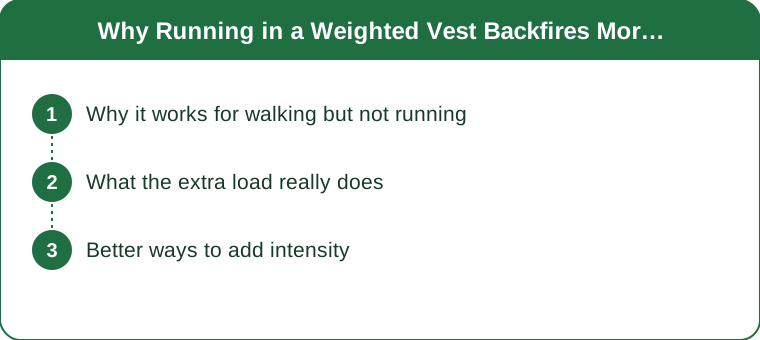
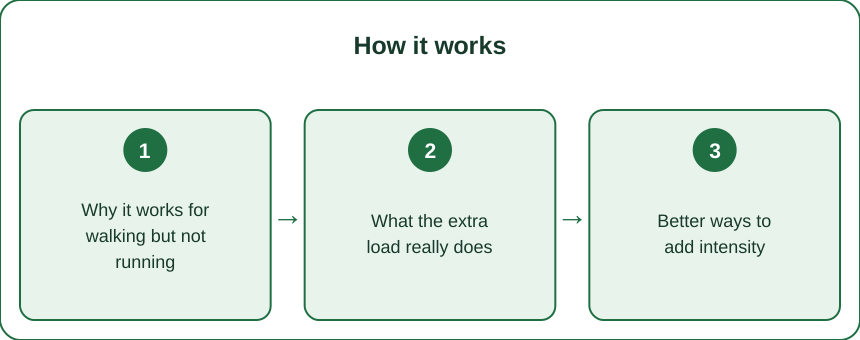
Why Does a Weighted Vest Work for Walking but Not Running?
Walking is a low-impact activity. At any moment one foot is on the ground, and peak ground reaction force sits at roughly 1.2x your bodyweight. Adding a vest raises the load your muscles and bones work against without dramatically increasing joint stress. That’s a useful trade — it’s the entire basis of rucking, and it builds strength and bone density well.
Running is a different animal entirely. There’s a flight phase where both feet leave the ground, so every landing absorbs your descent. Peak forces run around 2.5–3x bodyweight at each footstrike, and higher at faster paces.
Now add a 20 lb vest to a 150 lb runner. You haven’t added 13% to a gentle load — you’ve added 13% to a force that was already three times your bodyweight, and you’ve done it roughly 1,500 times per mile. That’s the accumulation problem: not one dangerous rep, but thousands of slightly-too-heavy ones.
The tissues that fail under that pattern are exactly the ones runners already struggle with: tibias (stress fractures), the medial shin (shin splints), Achilles tendons, and knees.

What the Extra Load Does to Your Form
The impact math is only half the problem. The other half is what the vest does to how you move.
It shifts your center of mass. Weight sits on your torso, above your hips, which encourages a forward lean and often a heavier heel strike. Both increase braking forces.
It bounces. Even a well-fitted vest has some vertical travel, and that travel is out of phase with your stride. Your trunk muscles spend the run fighting a load that keeps arriving late.
It fatigues your form faster. This is the real danger. Form breaks down under fatigue — stride shortens, hips drop, knees collapse inward — and running with degraded mechanics is where most overuse injuries actually begin. A vest gets you to that point in half the distance.
It restricts breathing. A snug vest across the chest limits ribcage expansion, which is a strange thing to do during the one activity where you want maximum ventilation.
So you end up running slower, with worse mechanics, under more stress, for less distance. Every variable moved the wrong direction.
What Nobody Tells You About Vest Running
- The “weighted vest athletes” you’ve seen are doing something else. Military and tactical training uses loaded runs deliberately because carrying load under fatigue is the actual job requirement. It comes with an accepted injury rate. It’s occupational preparation, not a fitness optimization.
- 5% bodyweight is the commonly cited ceiling, and even that’s for experienced runners on soft surfaces, short distances, and with progressive buildup. For a 150 lb runner that’s 7.5 lb — far less than the 20 lb vest most people buy.
- Rucking gives you nearly all the benefit at a fraction of the risk. Walking with 20–30 lb for 45 minutes builds legs, bone density, and aerobic base without the flight phase.
- The vest doesn’t make you faster. There’s no reliable evidence that loaded running improves unloaded running speed. The transfer people hope for mostly doesn’t happen.
- Bone adapts slower than muscle. You’ll feel strong enough to keep going weeks before your tibia has adapted to the new load. That gap is where stress fractures live.
Better Ways to Make Your Runs Harder
If what you want is more challenge, these deliver it without stacking impact:
Hills. Uphill running raises intensity substantially while reducing impact forces compared to flat running, because you’re landing on a rising surface. It builds glutes and calves hard. Start with 6 x 30-second hill efforts with walk-down recovery.
Intervals. Effort goes up, joint load per stride does not. 8 x 400m at a hard-but-controlled pace with 90 seconds recovery is a classic for a reason.
More volume, slowly. The 10% rule — add no more than 10% to weekly mileage — is unglamorous and it works.
Strength training with the vest. This is where it genuinely shines: weighted squats, lunges, step-ups, push-ups, and pull-ups. Same equipment, real strength and bone benefit, none of the repetitive impact.
Rucking. Walk with the vest for 45–60 minutes. It’s the vest’s best use case and it’s very hard to injure yourself doing it.
FAQ
Is it ever OK to run in a weighted vest?
For a well-conditioned runner, occasional short efforts with under 5% of bodyweight on a soft surface are unlikely to cause harm. That’s a narrow window — short, light, soft, and infrequent — and it’s not where most people who buy a vest end up.
How much weight is safe in a vest for walking?
Walking tolerates far more: 10–20% of bodyweight is a common rucking range, built up gradually over several weeks. A 150 lb walker might work up to 15–30 lb comfortably over a couple of months.
Will a weighted vest help me lose weight faster?
It raises energy expenditure modestly during the session, but the effect is smaller than most people expect and it doesn’t outweigh the injury risk during running. Using the vest for longer, more frequent walks gets you more total calories burned than a shorter, riskier loaded run.
TL;DR:
- Running already loads joints at 2.5–3x bodyweight per stride; a vest multiplies exactly that.
- Vests also degrade form, shift your center of mass, and restrict breathing.
- Use hills and intervals for more running intensity — hills raise effort while lowering impact.
- Save the vest for walking, rucking, and bodyweight strength work.
- If you insist on running with one, keep it under 5% bodyweight and short.
This is general information, not medical advice. Talk to a physician or physical therapist before adding load to your running, especially with any history of stress fractures or joint pain.
Keep Reading
This article is for general informational purposes only and is not medical advice. Always consult a qualified health professional for guidance specific to you.