Five Rules for Adding a Weighted Vest to Your Fall Walks
Quick Answer: A weighted vest raises the cost of walking by roughly the percentage of body weight you add, and it works because it loads bone and muscle without adding impact. The five rules: start at 5 percent of body weight, progress weight before distance, fit it high and tight, keep your posture honest, and cap it at 10 to 15 percent unless you are training for something specific.

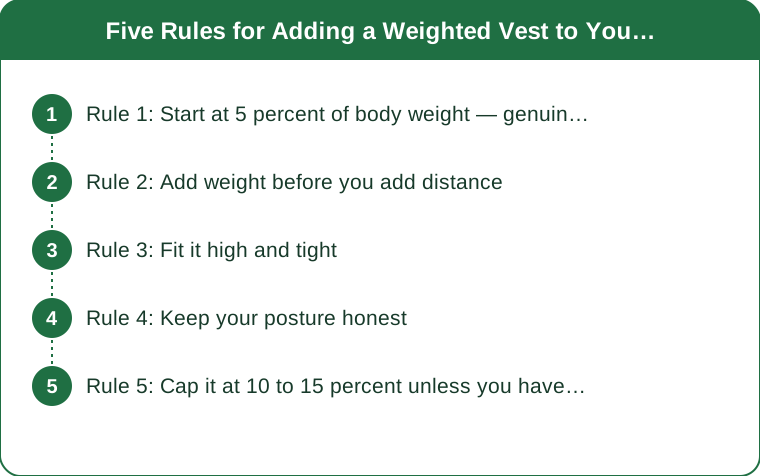
Rule 1: Start at 5 percent of body weight — genuinely
The most common mistake is starting at the weight you think you can handle rather than the weight your tissue is prepared for.
Five percent of body weight is the sensible starting load. For a 150-pound person that is around 7 or 8 pounds, which will feel almost insultingly light for the first ten minutes and noticeably present by minute forty.
The reason to start low is that the adaptations you want happen in connective tissue and bone, and those adapt considerably more slowly than muscle does. Your legs can handle 20 pounds today. Your Achilles, your plantar fascia and your lower back need weeks to catch up, and they are what actually gets injured.
Give it two to three weeks at the starting load before adding anything. If you have any history of low back, hip or foot issues, start at the bottom of the range and take longer.
A useful sanity check: if your gait changes while wearing it — shorter steps, a lean, a heavier heel strike — the load is too high right now, regardless of how it feels in your legs.
Rule 2: Add weight before you add distance
Two variables, and changing both at once is how people end up with a sore back and no idea which change caused it.
The general progression that works: hold your distance steady, increase the weight gradually, and only extend the walk once the weight feels routine.
A workable ramp: add 2 to 5 pounds every two to three weeks, keeping your usual route. Once you are at your target load and it feels unremarkable, then start extending the walk by roughly 10 percent per week.
Why this order: weight increases the intensity of each step, while distance increases the total number of loaded steps. Total loaded steps is what accumulates into overuse problems, so it is the variable to be more careful with. A 30-minute walk with more weight is a safer progression than a 60-minute walk with the same weight.
And take a week off the vest occasionally. Walking unloaded is not lost time — it lets connective tissue consolidate, and it tells you how much the vest is actually contributing.

Rule 3: Fit it high and tight
Where the weight sits changes what the vest does to your spine.
The load should sit high on the torso, close to your center of mass, and it should not move. A vest that rides low or bounces creates a repeated small pulling force on your low back with every step — thousands of times per walk.
What to check:
Tighten the side straps until the vest does not shift when you jog three steps. If it moves, it is too loose, and loose is where the back pain comes from.
Weight distributed front and back, not concentrated in front. Front-heavy vests pull you into a forward lean, which your low back then resists for the whole walk.
Shoulder straps wide and padded. Narrow straps concentrate pressure at the top of the trap, which is the most common complaint after the low back.
Nothing bouncing. Loose weight plates or a half-filled compartment turn a steady load into repeated impacts. Fill it fully or redistribute.
If you have the choice, a fitted vest beats a backpack for walking, because the load sits closer to your spine and does not swing.
Rule 4: Keep your posture honest
The vest amplifies whatever your posture already does, which is useful feedback and a real risk.
Watch the forward lean. The instinctive response to front-loaded weight is to lean back, and to back-loaded weight is to lean forward. Both put your lumbar spine into a sustained position it does not enjoy for an hour. Stay stacked — ribs over pelvis, and let the hips carry the load.
Do not let your stride shorten. Shortened, shuffling steps under load increase impact per step and reduce the glute contribution. Keep your normal walking stride; if you cannot, take weight off.
Check in every ten minutes. Shoulders down, chest open, gaze forward. Fatigue collapses posture gradually, and the last twenty minutes of a walk is where the poor positions accumulate.
Stop if your low back is talking. Not soreness the next day, which is normal early on — pain during the walk. That is the signal to reduce weight or shorten the walk, and continuing through it is how a manageable load becomes a multi-week problem.
The honest test: film yourself walking thirty seconds with and without the vest. If your posture visibly changes, the load or the fit needs work. This is general information, not medical advice — existing back issues deserve a professional opinion first.
Rule 5: Cap it at 10 to 15 percent unless you have a reason
There is a point where more weight stops adding benefit and starts adding cost.
For general fitness, bone loading and increased energy expenditure, 10 percent of body weight is a strong working load and 15 percent is a reasonable ceiling. Beyond that, the gait changes become significant and the injury risk rises faster than the benefit.
What the load is actually buying you: energy expenditure rises roughly in proportion to the added weight, so 10 percent more weight is roughly 10 percent more work. That is meaningful across an hour, and it is not transformative — the vest is a multiplier on walking, not a substitute for training.
Where heavier is justified: if you are specifically training for rucking, hiking with a pack, or an event with a load standard, then progressing beyond 15 percent is the point of the exercise. That is a training program, not a walk.
Where heavier is not justified: trying to make a walk into a strength session. Resistance training builds strength; a vest makes walking harder. They are different jobs and the vest is a poor substitute for the first one.
Should I wear it for running?
Generally no. Impact forces are already 2 to 3 times body weight in running, and adding load multiplies that. Vests are best used for walking, hiking and stair climbing.
How often should I wear it?
Two to four walks a week is plenty, with unloaded walks in between. Every single walk under load is how overuse problems start.
Does it actually help bone density?
Weight-bearing loading is one of the established stimuli for bone, and adding load increases that stimulus. It is a reasonable and low-cost addition, especially alongside resistance training rather than instead of it.
TL;DR:
- Start at 5 percent of body weight and hold it for two to three weeks — bone and tendon adapt far slower than muscle.
- Progress weight before distance, adding 2 to 5 pounds every two to three weeks on your usual route.
- Fit it high and tight with the load balanced front and back — a vest that shifts is what causes low back pain.
- Keep your normal stride and stacked posture; if either changes, the load is too heavy today.
- Cap at 10 to 15 percent of body weight unless you are training for a specific loaded event, and skip the vest for running.
Keep Reading
This article is for general informational purposes only and is not medical advice. Always consult a qualified health professional for guidance specific to you.