Five Weighted Vest Mistakes in the First Month
Quick Answer: Almost every weighted vest problem in the first month traces to one of five things: starting too heavy, wearing it too long, distributing the weight badly, using it on the wrong activities, or ignoring what it does to your gait. The general guidance is to start at roughly 5 percent of bodyweight, keep the first sessions to 20 to 30 minutes on flat ground, tighten it high and snug on the torso, and treat it as a walking and carrying tool rather than a running or jumping one.
The vest arrived, you loaded it up, and you did your normal hour.
Then your shoulders, your lower back and your shins spent the next three days explaining the problem with that plan.

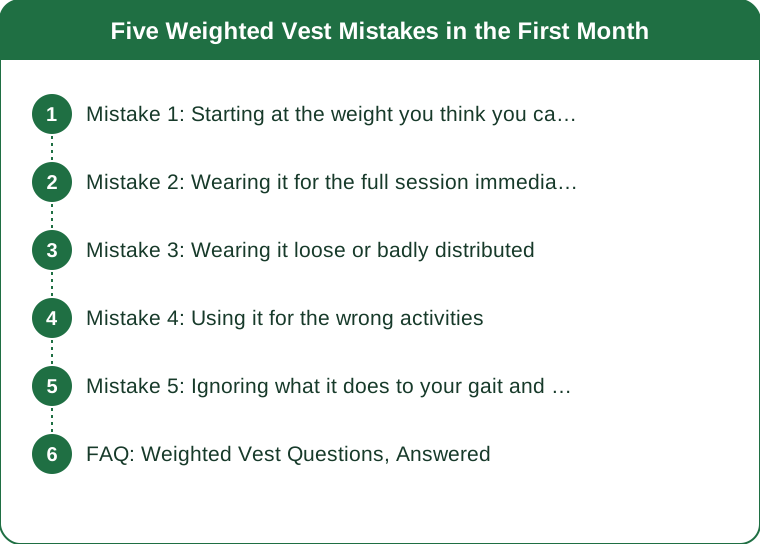
Mistake 1: Starting at the weight you think you can handle
5 percent of bodyweight is the usual starting point for walking, which for many people is a good deal less than the vest can hold.
The limiting factor is not your legs, which are already carrying you around all day - it is the shoulders, the spine and the connective tissue that have never carried load like this.
Progress by adding roughly 5 to 10 percent of the current load every week or two, rather than adding a plate whenever it feels easy.
10 percent of bodyweight is a solid intermediate target, and 20 percent is a genuinely advanced load for walking.
Perceived effort lags the tissue. A weight that feels easy on the day frequently produces soreness two days later, which is the signal that the progression was too fast.
And a vest that only adjusts in large increments makes sensible progression difficult - buy the one with small plates.
Mistake 2: Wearing it for the full session immediately
Start with 20 to 30 minutes, even if your usual walk is an hour.
Duration matters as much as load, since the tissue stress is cumulative across the session rather than set by peak weight.
Build duration before building weight, which is the standard order and the one most people reverse.
Wearing it all day around the house is a common early idea and a poor one, since postural fatigue accumulates in a way that is hard to notice until it is a problem.
Two or three sessions a week is plenty at the start, with normal unweighted walking in between.
And take it off for the last portion of a long walk rather than pushing through, since form degradation under fatigue is where the injuries come from.
Mistake 3: Wearing it loose or badly distributed
A loose vest bounces, and bouncing weight produces impact forces well above the static load.
Tighten it so it moves with your torso, which is the single most important fitting point and the one that determines comfort.
Weight should sit high on the torso and close to the spine, since load further from the body’s centre line increases the leverage on your back.
Balance front and back plates evenly, as an uneven vest tilts the torso and produces one-sided lower back complaints.
Wear a smooth base layer under it, because chafing at the shoulders and under the arms is the most common reason vests end up in a cupboard.
And check the fit again after ten minutes of walking, since straps loosen as the vest settles.

Mistake 4: Using it for the wrong activities
Walking and hiking are the best uses, and steady incline walking with a vest is one of the most effective and lowest-risk applications there is.
Running with a vest raises impact forces substantially and is not a beginner application - the loading rate on every step goes up along with the weight.
Jumping, plyometrics and high-impact classes with a vest are for advanced use and small loads, if at all.
Bodyweight strength work - push-ups, pull-ups, step-ups, lunges - is an excellent use, since the movement is controlled.
Yoga and floor work with a vest is generally a poor idea, since the load interferes with the positions rather than progressing them.
And carrying loads for cardiovascular work has a long, well-established history, which is exactly the walking and hiking application rather than the running one.
Mistake 5: Ignoring what it does to your gait and posture
Added front load pulls you forward, and the natural compensation is to lean back at the lower spine, which is where the ache comes from.
Stay tall with the ribs stacked over the pelvis, and shorten your stride slightly rather than reaching.
Shoulder pain in the first weeks is usually strap pressure plus a forward head position, not a shoulder problem.
Watch your shins, since the increased load raises impact through the lower leg and shin soreness is a common early complaint.
Stop if your gait changes noticeably - limping, shuffling or an obvious lean means the load or the duration is too much for today.
And be cautious if you have existing back, hip or knee issues, since a vest amplifies whatever load pattern you already have. Talk to a clinician before starting.
This is general information, not medical advice.
FAQ: Weighted Vest Questions, Answered
How much weight should I start with?
Around 5 percent of bodyweight for walking, building gradually toward 10 percent as tissue adapts.
How often can I use it?
Two or three sessions a week at the start, with unweighted walking on other days, is a reasonable structure for most people.
Is a vest or a rucksack better?
A vest distributes load more evenly across the torso; a rucksack concentrates it on the shoulders and upper back but is easier to adjust. Both work for walking - the vest is generally more comfortable at lower loads.
Does it help bone density?
Weight-bearing exercise supports bone health, and added load is part of that picture. It is one input among many, and not a treatment - discuss it with a clinician if bone density is your specific goal.
Can I wear it while running?
Not as a beginner. Impact forces rise substantially with added load, and running is where vest-related injuries concentrate.
Why do my shins hurt?
Increased load raises impact through the lower leg. Reduce weight or duration, check your shoes are not worn, and build more gradually.
This is general information, not medical advice.
TL;DR:
- Start at roughly 5 percent of bodyweight, not what the vest can hold.
- Build duration before weight - 20 to 30 minutes first, two or three times a week.
- Tighten it high and snug, balance front and back plates, and wear a smooth base layer.
- Walking, hiking and controlled bodyweight strength work are the good uses; running and jumping are not beginner applications.
- Watch for a changed gait, a backward lean or shin soreness - all signs the load or duration is too much.
The vest is not the training. The progression is.
Keep Reading
This article is for general informational purposes only and is not medical advice. Always consult a qualified health professional for guidance specific to you.