How Much Weight Should Your Vest Be? Start Lighter, Progress Slower
Quick Answer: Start at 5 percent of your body weight for walking — about 8 pounds for a 160-pound person — and stay there for two to three weeks before adding anything. Progress duration first, then terrain, then load, in that order, moving in 2-to-3-pound steps toward a working range of 10 percent for regular walks, with 15 to 20 percent reserved for shorter, deliberate ruck-style sessions after months of adaptation. Joints, posture, and feet adapt slower than enthusiasm; the number on the vest matters less than the ladder you climb to it.
The vest is a dosage tool. Nobody brags about starting doses, and nobody should.

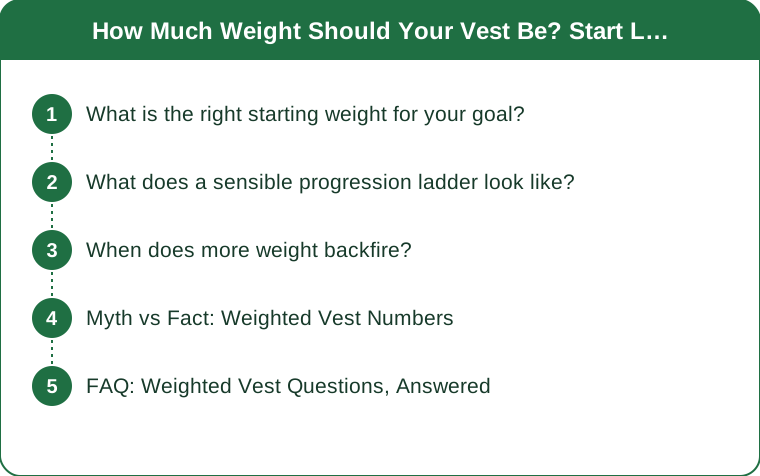
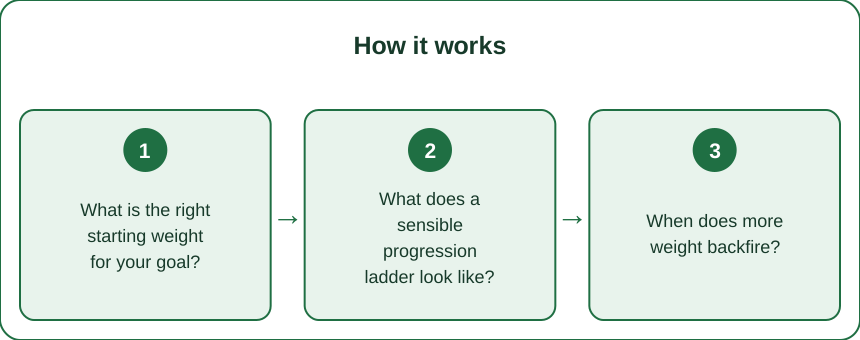
What is the right starting weight for your goal?
Five percent of body weight covers almost everyone. The goal adjusts the ceiling, not the start.
For everyday walking — the most common use — begin at 5 percent. For a 140-pound walker that is 7 pounds; for 180 pounds, 9. It will feel almost disappointingly light for the first ten minutes, which is correct: the load is repeated for thousands of steps, and per-step modesty is the entire design. By the final third of a 45-minute walk, 5 percent introduces itself properly.
Adjust the start down, not up, for these cases: any history of knee, hip, or lower-back trouble; postpartum return; osteoporosis or osteopenia without clearance (get clearance — loading may be genuinely useful, and the professional supervising you should set the dose); and anyone whose unweighted walks are not yet routine. Start at 3 to 4 percent or simply walk more first.
For workout use — squats, lunges, push-ups, stair sessions: the same 5 percent start behaves very differently in exercise than in walking, because single movements concentrate what walking distributes. A vest that whispers on a stroll speaks loudly in a lunge.
For hiking: count your pack. The vest adds to everything else you carry, and the combined number is the real load.
For bone-density motivation specifically: the research picture supports loaded walking and exercise as part of the toolkit, with programs typically building gradually toward meaningful percentages over months under guidance. The takeaway is the same ladder, climbed patiently — not a heavy vest on week one.
Fit matters as much as weight. A vest that rides snug against your torso — worn over a fitted tank or workout top, not a loose tee that bunches — moves with you instead of oscillating against your spine with every step. Loose vests make light weights feel bad and get blamed for what the straps did.
What does a sensible progression ladder look like?
Duration, then terrain, then load — each dial turned alone, each turn given two weeks.
Phase one, weeks 1 to 3: own the starting weight. Wear 5 percent on two to four walks a week at your normal duration. You are letting feet, calves, knees, and posture meet the new normal. Boredom here is the sign it is working.
Phase two: extend duration. Add 10 to 15 minutes to your weighted walks before touching the weight. Time under light load builds the tissue tolerance that makes heavier load safe later — and for calorie-and-conditioning goals, added minutes outperform added pounds anyway.
Phase three: add terrain. Hills and stairs multiply the training effect of the same vest dramatically. A 5-percent vest on a hilly route out-trains an 8-percent vest on flat sidewalk, at lower joint cost per minute.
Phase four: add load, 2 to 3 pounds at a time, no more often than every two weeks, walking each new weight for several sessions before judging it. The working destination for most regular walkers is around 10 percent of body weight — a load you can carry with normal posture, normal stride, and a conversation.
Beyond 10 percent — the 15-to-20 territory — belongs to deliberate, shorter ruck-style sessions, once or twice a week, after months on the ladder, with real attention to shoes and recovery. It is a legitimate training zone; it is not an everyday-walk zone.
The permanent rules on every rung: posture is the gauge — the moment you lean forward, shorten your stride, or brace your lower back, the dose is too high for today. And the vest comes off for some walks forever; unweighted days are part of the program, not a lapse.

When does more weight backfire?
When the signal changes location. Muscles complaining is training; joints and gait complaining is the invoice.
Watch where the fatigue lives. Worked calves, glutes, and shoulders after a vest walk: expected. Aching knees, a compressed-feeling lower back, sore hips at night, or foot pain the next morning: the load outran the adaptation, and the fix is dropping back a rung for two weeks, not pushing through.
Gait change is the earliest warning, visible before pain arrives. Overloaded walkers shorten their stride, land heavier, and lean forward. If your shadow looks different or your footsteps got audibly louder, the vest is rewriting your mechanics — and joints pay for rewritten mechanics at compound interest.
Plantar surfaces and Achilles carry the hidden cost. Every vest pound is added to every one of ten thousand steps. Feet adapt slower than motivation; morning heel pain is the classic overshoot signal, and cushioned, supportive shoes are non-negotiable equipment from the first weighted week.
Breathing tells on over-tight straps. A vest cinched hard enough to restrict rib expansion turns a walk into unintentional breathing practice. Snug enough not to bounce, loose enough for a full breath.
Skip the vest entirely for running unless you are experienced and deliberate. Impact forces multiply vest load in ways walking never does; the walking ladder does not transfer, and knees discover this immediately.
And separate soreness from setback honestly. New-load muscle soreness fades in 48 hours and improves with repetition. Anything sharp, one-sided, joint-centered, or persistent past a few days is a see-someone signal — the vest can wait; the tendon cannot.
This is general guidance, not medical advice. Anyone with bone density conditions, joint replacements, cardiac history, or current pain should get personal clearance before loading walks.
Myth vs Fact: Weighted Vest Numbers
Myth: Heavier vests burn dramatically more calories. Fact: The calorie bump from a 10-percent vest on a walk is real but modest — meaningfully less than adding fifteen minutes or a couple of hills. The vest’s best returns are strength, bone loading, and conditioning, not a fat-loss cheat code.
Myth: You should start at 10 percent because that is the number everyone quotes. Fact: Ten percent is a fine working destination, not a doorway. The people who skip the 5-percent on-ramp are the ones writing shin-splint posts in week three.
Myth: If the vest feels easy, it is doing nothing. Fact: Light load repeated thousands of steps is doing quiet structural work the whole time — that is the entire mechanism. Ease at step one and honest fatigue by minute forty is the target sensation, not struggle at step one.
Myth: A backpack works exactly the same. Fact: A pack concentrates load behind you and pulls your posture backward-then-forward; a vest distributes it around your torso and mostly leaves your gait alone. Packs work — rucking is built on them — but the numbers on this page assume vest-style distribution.
Myth: More weight is always the next step. Fact: Duration and terrain are earlier, cheaper rungs with better safety margins. Load is the third dial, and plenty of successful vest walkers park at 8 to 10 percent for years and simply walk further and hillier.
FAQ: Weighted Vest Questions, Answered
How much weight should a beginner put in a vest?
About 5 percent of body weight for walking — 7 to 9 pounds for most people — held for two to three weeks before any increase. Start at 3 to 4 percent with joint history, postpartum return, or bone-density conditions pending professional clearance.
How fast can I add weight?
Two to three pounds at a time, no more often than every two weeks, and only after duration and terrain have been progressed first. The working range for everyday walks is around 10 percent; 15 to 20 percent belongs to occasional deliberate sessions after months of laddering.
Is a weighted vest good for bone density?
Loaded walking and exercise are supported parts of the bone-health toolkit, particularly for postmenopausal women — with doses built gradually and ideally set with a professional if you have osteopenia or osteoporosis. The ladder matters more than the destination number.
Can I wear the vest every day?
Better not to at first. Alternate weighted and unweighted walks so feet and joints get adaptation days; daily wear is an earned privilege after a couple of months at a stable, comfortable load.
TL;DR:
- Start at 5 percent of body weight for walking and hold it two to three weeks; the right starting dose feels almost too light.
- Progress duration first, then terrain, then load in 2-to-3-pound steps — destination around 10 percent for daily walks, 15 to 20 only for occasional trained sessions.
- Posture and gait are the gauges: leaning, shortened stride, louder footsteps, or joint-centered aches mean drop a rung.
- Snug fit over a fitted layer, cushioned shoes, and unweighted days are permanent parts of the program.
Weigh yourself, take 5 percent, and load exactly that tonight. The ladder starts boring on purpose — climb it anyway.
See It in Motion
Seen here: Maternity Capris with Side Pockets — shop it on bubblelime.com
Keep Reading
This article is for general informational purposes only and is not medical advice. Always consult a qualified health professional for guidance specific to you.