5 Everyday Situations Where a Weighted Vest Actually Makes Sense (and 5 Where It Doesn't)
Quick Answer: A weighted vest adds genuine value during walking, stair climbing, and light household movement at a modest weight (5-10% of body weight), but should generally come off for tasks involving bending, lifting, or prolonged sitting, where the added load shifts from beneficial to potentially strain-inducing.

Look 1: Daily Walks — A Strong Fit
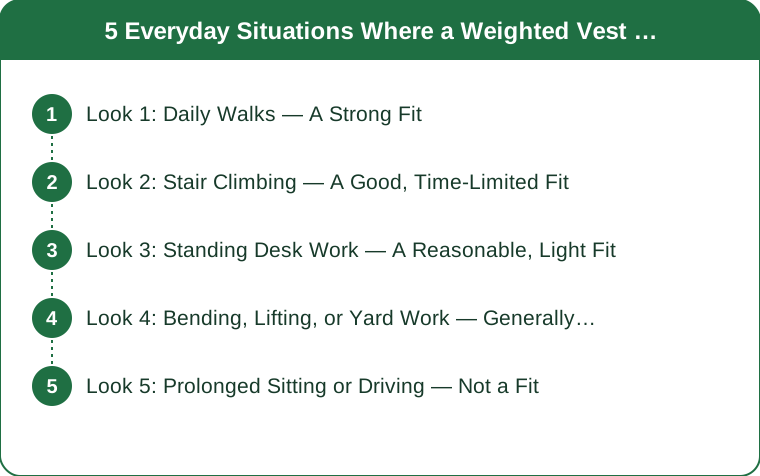
Wearing a weighted vest during a regular daily walk is one of the most well-supported everyday uses, adding a modest cardiovascular and bone-density stimulus to a low-impact activity you’re likely doing anyway. Keeping the weight to roughly 5-10% of body weight for this kind of extended, low-intensity wear avoids the joint strain risk that comes with heavier loads over a long duration.
Look 2: Stair Climbing — A Good, Time-Limited Fit
Stair climbing with a weighted vest amplifies the strength and cardiovascular benefit of an already effective movement, but works best in shorter, more intentional bouts rather than all-day wear, since stairs add more joint impact per step than flat walking. Removing the vest for casual, incidental stair use throughout the day and reserving it for a dedicated stair-climbing session is a reasonable distinction.

Look 3: Standing Desk Work — A Reasonable, Light Fit
For standing desk work, a light vest can add a small, low-effort activation benefit during otherwise sedentary desk time, though this is a minor benefit compared to dedicated movement. It’s worth prioritizing comfort and posture awareness over pushing weight in this context, since the goal here is a light bonus, not a training stimulus.
Look 4: Bending, Lifting, or Yard Work — Generally Not a Fit
Tasks involving repeated bending, lifting, or twisting (gardening, moving boxes, deep cleaning) are generally better done without a weighted vest, since the added load changes the biomechanics of already-loaded movements in ways that can meaningfully increase strain risk, especially on the lower back. The vest’s benefit in walking comes from a relatively simple, repetitive motion — bending and lifting are a different category of movement demand entirely.
Look 5: Prolonged Sitting or Driving — Not a Fit
Wearing a weighted vest during extended sitting, including driving, provides essentially no meaningful training benefit while adding unnecessary discomfort and, in a driving context specifically, a genuine safety consideration around freedom of movement and seatbelt fit. This is one of the clearer ‘take it off’ scenarios rather than a borderline case.
What weight is appropriate for all-day or extended everyday wear?
Most guidance suggests staying at the lower end (around 5%) of body weight for extended wear throughout a day, reserving higher percentages for shorter, dedicated training sessions.
Can wearing a weighted vest too often for everyday tasks cause problems?
Yes, particularly for the spine and joints if worn during activities it isn’t well suited for (bending, lifting) or at too high a weight for extended daily wear — matching the situation to appropriate use matters more than maximizing wear time.
Is it worth buying a vest specifically for everyday wear versus workout-only use?
Some vests are designed with everyday comfort (better weight distribution, breathable fabric) specifically in mind, which is worth considering if extended daily wear beyond workouts is the actual goal.
TL;DR:
- Walking and stair climbing are strong everyday fits for a weighted vest at a modest 5-10% body weight load
- Standing desk work offers a small, low-effort bonus benefit, worth keeping light rather than heavy
- Bending, lifting, and yard work generally call for removing the vest due to increased strain risk
- Prolonged sitting or driving offers no real benefit and adds unnecessary discomfort or safety concern
A weighted vest isn’t an all-day accessory by default — matching when you wear it to what the activity actually rewards is what makes it a genuinely useful tool instead of just extra weight.
Keep Reading
This article is for general informational purposes only and is not medical advice. Always consult a qualified health professional for guidance specific to you.