How Heavy Should Your Weighted Vest Actually Be?
Quick Answer: For walking and general conditioning, start at 5-10% of your bodyweight; for strength-focused work like weighted vest squats or step-ups, 10-15% is a common effective range — going heavier than 15-20% starts compromising form for most people.
You bought a weighted vest, strapped in the heaviest plates it holds, and immediately felt your posture cave forward. More weight isn’t automatically better — there’s a real range where a vest helps, and a point past which it just makes you compensate.

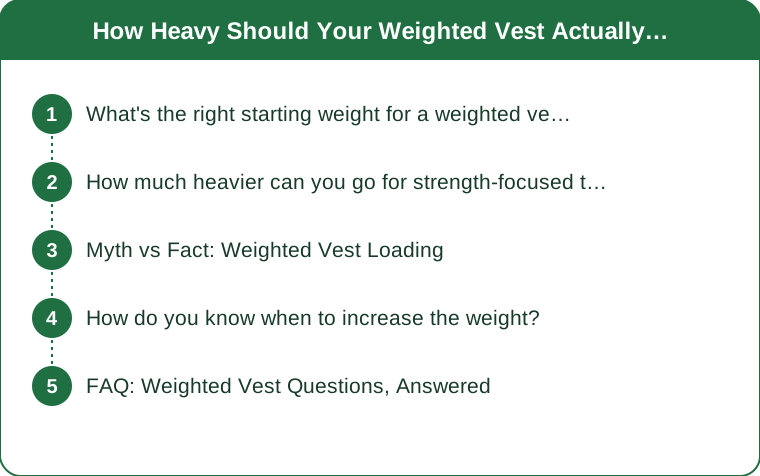
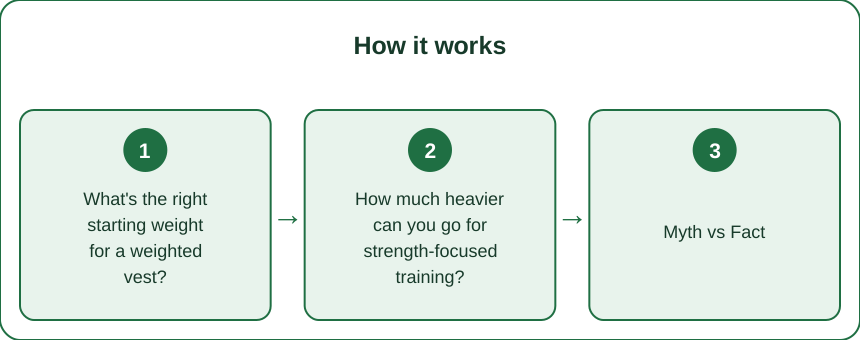
What’s the right starting weight for a weighted vest?
5-10% of your bodyweight is the standard starting range for walking, hiking, or general conditioning use — light enough to maintain normal posture and gait, heavy enough to add a genuine training stimulus.
For a 150lb person, that’s roughly 7.5-15 lbs to start. Build up gradually from there rather than guessing high on day one.
How much heavier can you go for strength-focused training?
For loaded carries, weighted step-ups, or vest-based strength circuits, 10-15% of bodyweight is a commonly used effective range in strength research, with some well-conditioned athletes working up toward 20% for specific short-duration exercises.
Past roughly 20%, most people start losing proper form — rounded shoulders, altered gait, or compensating joint angles — which shifts the exercise from ‘added resistance’ to ‘fighting the weight,’ undermining the training benefit.

Myth vs Fact: Weighted Vest Loading
Myth: Heavier is always more effective for weighted vest training. Fact: Past the point where form breaks down, extra weight adds injury risk without adding proportional training benefit.
Myth: You should wear the same weight for every activity. Fact: Walking, running, and strength work all tolerate different loads — running with a vest generally calls for lighter loads (5% or less) than walking, due to impact forces.
Myth: A weighted vest is inherently more dangerous than other resistance training. Fact: At an appropriate percentage of bodyweight with good form, it’s a well-supported training tool — the risk comes specifically from overloading past your form’s ability to hold up.
How do you know when to increase the weight?
If your current weight feels easy to maintain normal posture and full range of motion through your usual session length, it’s time to add roughly 2.5-5% of bodyweight and reassess, the same progressive overload logic as any other resistance training.
A useful check: if you can’t maintain a normal walking gait or your breathing pattern changes dramatically at the start of a session, that’s a sign to dial back rather than push through.
FAQ: Weighted Vest Questions, Answered
Is a weighted vest safe for running?
Yes, at lighter loads (typically under 5-10% of bodyweight) — running adds more impact force than walking, so the safe percentage range is lower.
How long should I wear a weighted vest per session?
For conditioning use, 20-45 minutes is common; for strength-focused exercises, shorter bursts (10-20 minutes within a larger workout) are typical.
Can a weighted vest replace strength training?
Not fully — it’s a good conditioning and load-bearing addition, but it doesn’t replace the range of stimulus a full strength program with varied movements provides.
TL;DR:
- Start at 5-10% of bodyweight for walking and general conditioning
- 10-15% works for strength-focused vest exercises; rarely go past 20%
- Running calls for a lighter load than walking due to impact forces
- If form breaks down at your current weight, dial back rather than push through
More weight isn’t the goal — the right weight for your activity and current form is.
Keep Reading
This article is for general informational purposes only and is not medical advice. Always consult a qualified health professional for guidance specific to you.