5 Weighted Vest Checks for a Dog or Stroller Walk
Quick Answer: A vest on a dog or stroller walk is a genuinely efficient way to add load to time you were spending anyway - but both activities apply asymmetric pull that a vest amplifies. Cap the load lower than you would for a solo walk (5-8% of body weight rather than 10%), and switch the leash or push hands every ten minutes.
The walk is happening regardless. Twice a day, thirty minutes, rain or shine.
So adding a vest looks like free training, and mostly it is - it is one of the few genuinely efficient ways to load a habit you already have.
But a leash pulls and a stroller pushes, and neither of those is symmetric. Five checks before you go.

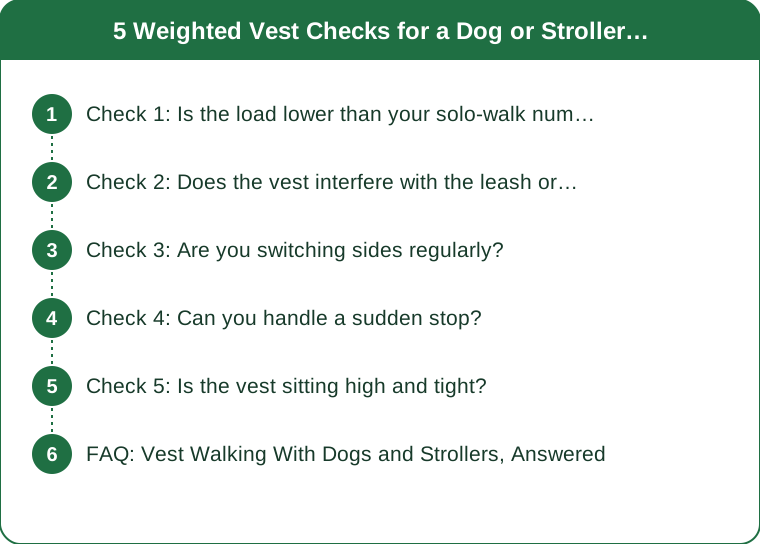
Check 1: Is the load lower than your solo-walk number?
The standard weighted vest guidance is up to about 10% of body weight for walking, built up gradually. For a leash or stroller walk, start lower - 5-8% - and treat that as the working ceiling rather than a starting point.
The reason is not that the walk is harder. It is that you now have a second, unpredictable load source. A dog that lunges at a squirrel applies a sharp asymmetric force through one arm and shoulder while your torso is carrying extra weight. Those two things interact.
What to do: if you walk at 10% solo, drop to 6-7% for dog walks and hold there for at least three weeks before considering more.
The check: if you find yourself bracing against the leash rather than walking with it, the combined load is too high.
Check 2: Does the vest interfere with the leash or handlebar?
This is the practical check people skip until something goes wrong.
A vest changes your torso circumference and where your arms hang. Common conflicts: a cross-body leash now rides on top of the vest and slips; stroller handlebars sit at a height calibrated for your unweighted posture and now feel low; a hip-belt or waist strap on the vest sits exactly where a running-stroller tether wants to go.
What to do: walk one lap of the block before committing to the route. Check that the leash runs clean, that the handlebar height still lets your elbows sit near 90 degrees, and that nothing rubs at the point where vest meets strap.
The check: any friction point you notice in the first five minutes becomes a raw spot by minute forty. Fix it now.
Check 3: Are you switching sides regularly?
Both activities are asymmetric by default. Dog walkers hold the leash in a dominant hand. Stroller pushers unconsciously favor one side, particularly when carrying a bag on the other shoulder.
Adding 10-20 lbs to your torso amplifies whatever asymmetry your walk already had, because your spine is now stabilizing more mass against the same one-sided pull.
What to do: switch the leash hand or your dominant push side every ten minutes. Set a repeating timer if you will not remember - and you will not remember.
The check: at the end of the walk, notice which shoulder or side of your neck is tighter. A meaningful difference means the switching is not happening often enough.
For stroller walks specifically, keep both hands on the bar as the default. One-handed pushing with a loaded torso is the setup most likely to produce a sore low back.

Check 4: Can you handle a sudden stop?
The scenario that matters: the dog stops dead, or lunges, or the stroller front wheel catches an edge. Your reaction involves a sudden shift of your center of mass, which is now higher and heavier than your body expects.
This is the one genuine added risk of vest walking with a dependent, and it is worth thinking about honestly rather than dismissing.
What to do:
- Use a hands-free or waist leash for a strong dog, so the pull goes through your hips rather than one arm
- Keep the vest load low enough that you can comfortably jog three steps to recover balance
- Skip the vest entirely on routes with unpredictable footing - wet leaves, gravel, uneven sidewalks
- Leave the vest at home for the first few walks with a new or reactive dog
The check: stand still with the vest on and shift your weight quickly side to side. If it takes an extra beat to feel stable, that is the beat you will not have when it matters.
Check 5: Is the vest sitting high and tight?
The general fit rule applies with more force here because you are wearing it longer and with more incidental movement than a workout.
A vest should sit high on the torso, with the weight distributed across the chest and upper back, snug enough that it does not bounce. A vest riding low pulls your center of mass forward and down, which produces exactly the forward-lean posture that leads to lower back complaints.
With a stroller, low-riding is worse than usual because you are already leaning slightly forward to push.
What to do: tighten the side straps until you can fit a flat hand under the vest but not a fist. Check it again at the ten-minute mark - vests loosen as you warm up and as fabric relaxes.
The check: jump lightly. If the vest moves independently of your torso, tighten it. Any independent movement over a 40-minute walk becomes chafing.
This is general information, not medical advice. Persistent shoulder, neck or back pain from vest walking is a reason to reduce the load and consult a professional, not to push through it.
FAQ: Vest Walking With Dogs and Strollers, Answered
Is this actually worth it compared to just walking faster?
Both work, and the vest has one advantage - it adds load without adding speed, which matters when your pace is set by a dog or a nap schedule. Weighted walking also produces bone-loading benefits that speed alone does not.
Can I wear a vest with a baby carrier?
No. A carrier already loads your torso, and stacking a vest on top is a shoulder and lower back problem waiting to happen. Pick one.
How long before it feels normal?
Most people adapt to a modest vest load in two to three weeks of regular walks. If it still feels heavy after a month, the load is too high rather than your fitness being too low.
TL;DR:
- Cap the load at 5-8% of body weight rather than the 10% you might use solo - the second, unpredictable load source is the reason.
- Walk one lap first to find leash and handlebar conflicts before they become raw spots.
- Switch leash hand or push side every ten minutes, with a timer.
- Skip the vest on unpredictable footing and with a new or reactive dog.
- The vest should sit high and tight enough that it does not move independently; re-check at ten minutes.
Loading a walk you were doing anyway is one of the highest-efficiency training decisions there is. It just needs the load set for two variables instead of one.
Keep Reading
This article is for general informational purposes only and is not medical advice. Always consult a qualified health professional for guidance specific to you.