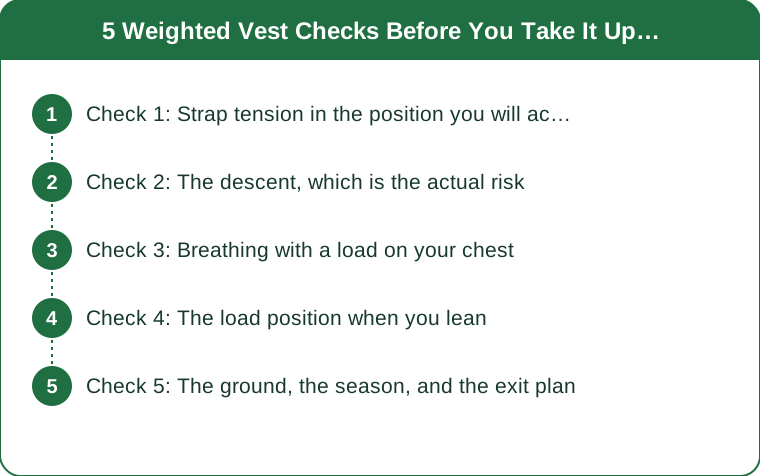
5 Weighted Vest Checks Before You Take It Up a Hill
Quick Answer: Adding a hill to a weighted vest walk changes five things: your torso leans forward so the vest shifts and rides up, the descent turns the added weight into extra eccentric load on your knees and quads, your shoulders carry more of the load as you lean, breathing gets harder with a chest-mounted load, and the ground underfoot is less predictable. Check strap tension in the leaning position, halve the weight you use on flat ground, and consider taking the vest off entirely for a steep descent.
The climb is a fitness question. The descent is a joint-loading question.
Check 1: Strap tension in the position you will actually be in
You fit the vest standing upright. You will not be standing upright.
Climbing a hill puts your torso into a forward lean, sometimes substantially. In that position a vest that sat perfectly on flat ground rides up toward your neck and shifts forward, changing where every strap pulls.
The fix takes ten seconds: fit it in the lean. Put the vest on, then lean forward to roughly the angle you will be climbing at, and tighten from there. Stand up and it will feel a touch snug, which is correct.
Check the shoulder straps specifically. In a forward lean, more of the load transfers onto the shoulders and away from the torso. Straps that were comfortable flat will bite on a climb.
Then check the bottom edge. A vest riding up means its lower edge sits at your ribs rather than your torso, which is both uncomfortable and where most vest-related bruising happens.
Retighten at the top of the climb. Everything loosens as fabric settles and you sweat, and the descent needs a tighter vest than the ascent because bouncing load is the problem going down.
Watch autumn layering. A vest fitted over a t-shirt in August sits differently over a fleece in October — usually looser once the layer compresses, which means it moves more. Refit whenever the layer changes.
Check 2: The descent, which is the actual risk
Going up is cardiovascular. Coming down is mechanical.
Descending loads the quadriceps eccentrically — lengthening under load to control each step. Adding vest weight increases that load on every single step, and the effect is proportionally larger than it is on the climb.
Knee joint forces rise noticeably going downhill compared with level walking, and added weight scales those forces directly. This is the specific combination that produces sore knees days later.
Delayed muscle soreness will be worse than you expect. Eccentric loading causes more muscle damage than concentric, and weight plus descent plus unaccustomed terrain is the highest-damage combination in ordinary walking.
What to do about it:
Take the vest off for a steep descent if your route allows it and you can carry it. This is not soft, it is the sensible allocation of load — you got the training effect on the way up.
Shorten your stride markedly. Smaller steps mean smaller drops and lower peak forces per step.
Use poles. They transfer real load off the legs during descent, and with added weight they matter more, not less.
Start with half the weight you use on the flat. If you walk with 10 kg on level ground, start hills with 5 kg and build over several outings.
Anyone with existing knee problems should be especially cautious, and adding load to a descent is worth clearing with a physiotherapist first.
Check 3: Breathing with a load on your chest
A vest restricts the mechanism you need most on a climb.
Vests sit across the chest and upper torso, and they restrict rib cage expansion to some degree. On flat ground with easy breathing that is barely noticeable.
On a climb, ventilation demand rises sharply — and that is exactly when restriction matters. The combination of higher demand and reduced chest expansion is why hills in a vest feel disproportionately harder than the added weight alone suggests.
Check the chest straps are not over-tightened. The instinct is to cinch everything down for stability, and a vest tight enough to feel completely locked is usually tight enough to restrict breathing. Snug, not compressed.
Take a deliberate full breath before you start climbing. If you cannot expand your chest fully, loosen the chest strap one notch.
Expect to slow down more than the weight suggests. A vest that adds 10 percent of your body weight will cost you more than 10 percent of your hill pace, and trying to hold your usual pace is how people end up over-exerting.
Cool autumn air helps here. Cooler, denser air is easier to work in than August humidity, and this is genuinely the best season for loaded hill walking.
Anyone with asthma or a respiratory condition should be cautious with chest-mounted loads on climbs and should discuss it with a doctor first.
Check 4: The load position when you lean
A forward lean turns a torso load into a shoulder-and-neck load.
Standing upright, a well-fitted vest distributes weight across the torso. Leaning forward transfers a much larger share of that weight onto the shoulders and upper back, and onto the neck extensors holding your head up against the lean.
This is why hill walking in a vest produces neck and trap soreness that flat walking does not.
Keep the weight distribution low and even. Weight plates positioned high on the chest amplify the lever effect during a lean. Where the vest allows adjustment, keep the load as low on the torso as the design permits.
Balance front and back. Front-loaded vests pull you further into the forward position you are already in on a climb, which stacks a postural problem on top of a load problem.
Keep the climb posture honest. Lean from the ankles rather than folding at the waist, keep the chest reasonably open, and avoid dropping the head to watch your feet continuously.
Look up regularly. A sustained head-down position on a long climb with load is where the neck complaints come from.
Shoulder ache during the walk is a fit problem; shoulder ache lasting days is a load problem. The first calls for adjusting straps, the second for reducing weight.
Check 5: The ground, the season, and the exit plan
Weight amplifies every consequence of a slip.
Added weight increases the force of any stumble and reduces your ability to correct it. Recovering from a slip requires rapid force production against your own momentum, and extra mass makes that harder — while also raising the impact if you go down.
Autumn ground is the specific hazard. Wet leaves on a slope are genuinely slippery, mud arrives, and hidden roots and stones disappear under leaf cover. This is the season where footing changes fastest.
Footwear matters more with load. Deeper lugs and a proper grip pattern, and check your tread before adding weight to a hill walk. Worn soles plus vest plus wet descent is the combination to avoid.
Daylight is shrinking. A loaded hill walk takes longer than the flat version, and starting a route at the same time as you did in July now finishes in the dark. Check sunset before you go and carry a light.
Have an exit plan. Be willing to take the vest off mid-walk, which is why a route you can do without it matters. If you cannot comfortably continue without the weight, the route is too committing for the load.
Do not wear a weighted vest on technical or exposed terrain. Scrambling, narrow paths with drops, or anything requiring hands is not the place for added weight and impaired balance.
Build the progression slowly. Add either weight or hill, never both at once, and give each step two or three outings before the next. That single rule prevents most of the problems on this list.
TL;DR:
- Fit the vest while leaning forward, not standing upright, and retighten before every descent.
- The descent is the real risk: added weight multiplies eccentric quad load and knee forces, so halve your flat-ground weight on hills.
- Do not over-tighten the chest strap — climbing needs full rib expansion, and hills cost more pace than the weight suggests.
- Wet autumn leaves, worn tread, and shrinking daylight all matter more when weight reduces your ability to recover from a slip.
Take the vest off for the steep descent. You already got the session on the way up.
Keep Reading
This article is for general informational purposes only and is not medical advice. Always consult a qualified health professional for guidance specific to you.