5 Weighted Vest Checks Before an Autumn Hill Walk
Quick Answer: Hills change a weighted vest more than any other variable. Descending with added load multiplies knee impact forces, wet ground reduces traction just as your effective weight goes up, and autumn layering changes how the vest sits. Before a hill walk, check: load is 5 to 10 percent of bodyweight, not more; the vest sits high and tight over your layers; the descent plan is realistic; the footwear grips wet ground; and you have somewhere to put weight if it goes wrong.
Five checks, two minutes, before you set off. Persistent joint pain deserves proper assessment - this is general information, not medical advice.
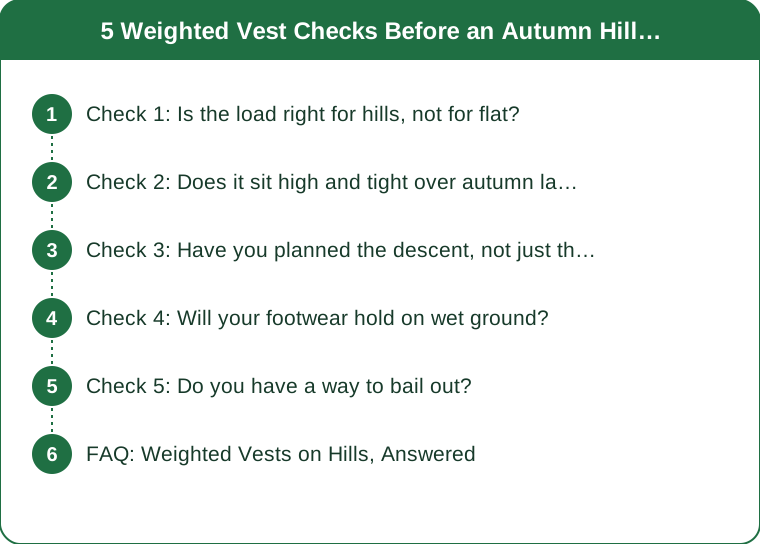
Check 1: Is the load right for hills, not for flat?
Flat-ground load is not hill load. A vest at 10 percent of bodyweight is comfortable on the level and considerably harder uphill, and genuinely demanding on a descent.
Descending is where the risk sits. Downhill walking already produces impact forces of roughly 3 to 5 times bodyweight at the knee, and adding a vest scales that up directly.
Drop to 5 percent of bodyweight for your first hilly walks with a vest, and build from there. For a 65 kg walker that is around 3 kg rather than 6.5 - and the difference on a long descent is very noticeable.
Check 2: Does it sit high and tight over autumn layers?
A vest worn over a fleece sits differently than over a t-shirt. The extra bulk loosens the straps’ effective grip, and a vest that shifts on a descent is both uncomfortable and destabilising.
Re-tighten after you put your layers on, not before. This sounds obvious and is the single most commonly skipped step at the start of a cold-weather walk.
Load should sit high on the torso, close to your centre of mass. A vest riding low pulls you backwards on descents and increases the lever on your lower back - both of which get worse as you tire.
Check 3: Have you planned the descent, not just the climb?
People plan hill walks by the ascent and treat the descent as the way home. With a vest, the descent is the harder and riskier half by a clear margin.
Choose a route with a gradual descent rather than a steep one where possible - a longer, gentler way down is a genuinely better choice with load.
Take the weight off for a steep descent if you have that option. Removing the vest, or removing some of its plates, for the steepest section is a sensible decision rather than a failure of ambition.
Check 4: Will your footwear hold on wet ground?
Traction demand rises with load. Extra weight increases the force your footwear has to resist on wet leaves, mud, and wet rock - all of which arrive together in autumn.
Check your outsole tread depth before the walk. Worn lugs fail first on wet descents, which is precisely where a loaded slip does the most damage.
Consider poles for any loaded hill walk. They transfer some load through your arms on the descent and add two points of contact on ground where traction is uncertain - the single best piece of kit for this situation.
Check 5: Do you have a way to bail out?
Removable weight is what makes a vest safer than a fixed load. Check before setting off that you can actually remove plates with cold hands, without tools, in the rain.
Plan the shortest way down from the halfway point. If a knee or a back starts complaining with load on, knowing the quickest exit turns a problem into an inconvenience.
Set a turnaround rule and hold to it. Deciding in advance - for example that you turn back if the descent looks steeper than planned - is far easier than deciding on the hill. Persistent joint pain with load is a stop signal, not something to walk off. This is general information, not medical advice.
FAQ: Weighted Vests on Hills, Answered
How much weight should I use for hill walking?
Start at 5 percent of bodyweight for hilly routes, rather than the 10 percent that is comfortable on the flat. Descending is where the added load costs most.
Why is going downhill harder with a vest?
Descending already produces impact forces around 3 to 5 times bodyweight at the knee, and added load scales that up directly while your quadriceps work eccentrically to brake.
Where should the vest sit?
High on the torso, close to your centre of mass, and tightened after your layers are on. A low or loose vest pulls you backwards on descents.
Do I need trekking poles?
For loaded hill walking, they are the most useful item you can carry. They transfer load through your arms on descents and add contact points on uncertain ground.
Should I take the vest off for steep sections?
If the descent is steep, yes - removing plates or the whole vest for that section is a sensible decision, not a failure.
What footwear check matters most?
Outsole tread depth. Worn lugs fail first on wet descents, and added weight increases the traction demand at exactly that moment.
When should I stop?
Any joint pain under load - particularly knee pain on descents - is a stop signal. Take the weight off and take the shortest way down. Persistent pain deserves proper assessment.
TL;DR:
- 5 percent of bodyweight for hills, not the 10 percent that suits flat ground.
- Descending is the hard half - impact already runs 3 to 5 times bodyweight at the knee before you add load.
- Tighten the vest after your layers are on, and keep the load high on the torso.
- Plan the descent, choose the gentler way down, and be willing to remove plates for steep sections.
- Check tread depth - traction demand rises with load, and wet autumn ground is unforgiving.
- Carry poles. For loaded hill walking they are the most useful item available.
- Set a turnaround rule and know the shortest way down before you start.
Joint pain under load is a stop signal, not something to walk off. This is general information, not medical advice.
Keep Reading
This article is for general informational purposes only and is not medical advice. Always consult a qualified health professional for guidance specific to you.