5 Signs You're Actually Ready to Add More Weight to Your Vest
Quick Answer: You’re ready to add weight when your current load feels comfortably manageable through a full session with normal posture and breathing, typically after 2-4 consistent weeks at the current weight, rather than adding weight based on a fixed timeline or how a previous, unrelated fitness level felt.

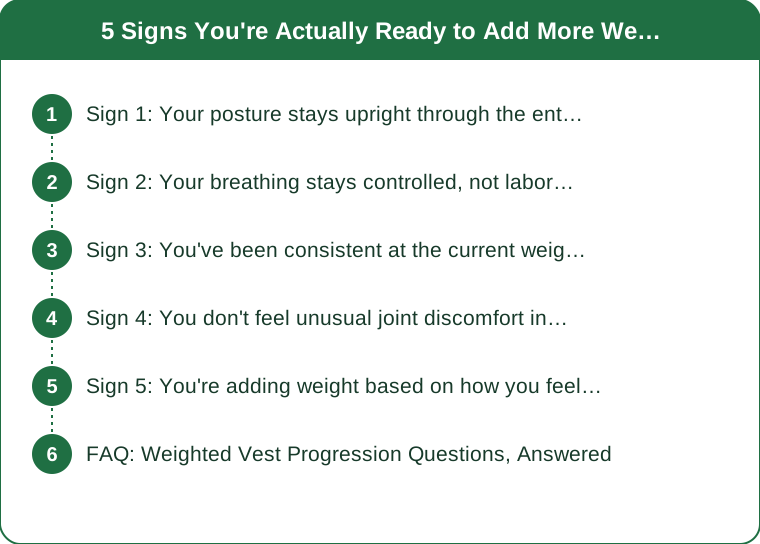
Sign 1: Your posture stays upright through the entire session at current weight
If you’re noticing any forward lean or shoulder rounding developing partway through a session at your current vest weight, that’s a sign the current load is already challenging your postural endurance, and adding more weight before fixing that would just compound the compensation pattern rather than build genuine strength.
Sign 2: Your breathing stays controlled, not labored, at your normal pace
A vest that’s appropriately loaded lets you maintain roughly the same breathing pattern you’d have without it, just with more effort required — if you’re noticeably more out of breath than expected relative to your normal unweighted pace at the same intensity, the current weight may still be appropriately challenging, and jumping up could push you into an unsustainable zone.
Sign 3: You’ve been consistent at the current weight for at least 2-4 weeks
Progressive overload works through gradual adaptation, and vest weight is no exception — jumping weight increases before your body has adapted to the current load (typically requiring a few weeks of consistent exposure) increases injury risk without proportionally increasing benefit, since the adaptation simply hasn’t caught up yet.

Sign 4: You don’t feel unusual joint discomfort in your knees, hips, or lower back
Weighted vest training adds compressive load through the spine and lower body joints, and any new or unusual joint discomfort at your current weight is a signal to stay at that level (or even reduce it) rather than progress, since joint tissue adapts more slowly than cardiovascular or muscular systems and needs more conservative progression.
Sign 5: You’re adding weight based on how you feel, not a fixed percentage jump
The safest progression is small (around 5-10% increases) based on genuine readiness signals, not a fixed schedule or comparison to what someone else is lifting — vest training guidelines commonly suggest staying under roughly 10% of body weight for regular use, and progressing toward that ceiling gradually rather than in large jumps.
FAQ: Weighted Vest Progression Questions, Answered
How much weight should I add at each progression step?
Small increments — roughly 5-10% of your current vest weight — allow your body to adapt gradually without the injury risk that comes from large jumps.
Is there a maximum weighted vest weight I shouldn’t exceed for regular training?
Many guidelines suggest staying at or under about 10% of body weight for consistent, regular-use training, with higher loads reserved for specific, supervised strength protocols rather than everyday wear.
Should I progress vest weight the same way for walking versus more dynamic exercises?
No — dynamic movements (like stair climbing or bodyweight exercises) generally warrant more conservative progression than steady walking, since the added load interacts differently with joint stress during dynamic versus steady movement patterns.
TL;DR:
- Readiness to add weight shows up as maintained posture, controlled breathing, and no new joint discomfort
- 2-4 weeks of consistency at a given weight is a reasonable baseline before progressing
- Small 5-10% increases are safer than large jumps, regardless of how ready you feel
- Most guidelines suggest staying under about 10% of body weight for regular training use The vest doesn’t care how motivated you feel today — genuine readiness signals from your body are still the safest guide for when to actually add more weight.
Keep Reading
This article is for general informational purposes only and is not medical advice. Always consult a qualified health professional for guidance specific to you.