5 Signs Your Weighted Vest Walks Need a Deload Week
Quick Answer: Weighted vest walking accumulates load without producing the obvious fatigue that heavy lifting does, so people ramp it continuously and never deload. The five reliable warning signs are shoulder and trap soreness that no longer resolves overnight, foot or shin pain that shows up in the first ten minutes, a drifting gait, sleep and mood changes, and a resting heart rate that has crept up. A deload here means removing the vest, not walking less.
You added a vest, then a bit more weight, then a bit more distance, and every single walk has felt completely fine. Then one morning your traps are sore before you have put anything on.
Vest walking hides its own dose, which is exactly why it needs deliberate deloading. The fourth sign is the one people attribute to everything except training.

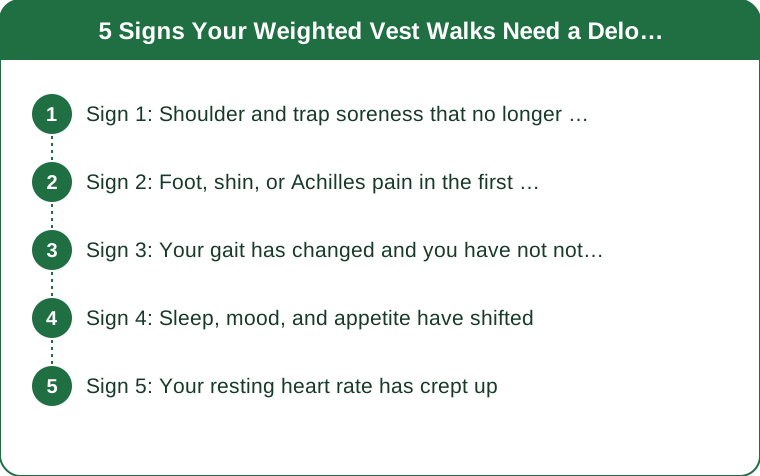
Sign 1: Shoulder and trap soreness that no longer clears overnight
The first and most specific signal, because it is the tissue taking the most novel load.
A vest hangs its weight from your shoulders and upper back. Unlike a barbell, which you hold for seconds, a vest applies that load continuously for 30 to 60 minutes. Your upper traps are doing a low-level isometric hold the entire time — which is a type of work most people never otherwise do.
Normal: mild upper-back tiredness after a walk that is gone by the next morning.
The warning sign: soreness that is still there 24 hours later, or that you notice on waking before you have done anything. When soreness stops resolving overnight, you have moved from stimulus to accumulation.
A second version of this: neck stiffness or tension headaches on the days after longer vest walks. Sustained trap loading with slightly elevated shoulders is a well-known contributor, and it usually means the vest is sitting too high or the straps are carrying more than the torso.
What to check before deloading: vest fit. A vest that rides high puts weight on your shoulders rather than distributing it across your torso. Tighten the side or waist straps so more of the load is carried against your trunk. Sometimes what looks like an overuse signal is a fit problem, and fixing the fit resolves it without changing your training at all.
If fit is good and the soreness persists across days: take a week without the vest.
Sign 2: Foot, shin, or Achilles pain in the first ten minutes
The timing of the pain tells you more than the pain itself.
Bone and tendon overuse issues have a characteristic pattern: pain at the start of activity, which eases as you warm up, and returns afterward. That is different from muscle soreness, which is present throughout and often worst at the end.
If your shins, arches, or Achilles hurt in the first ten minutes and then settle, that is the pattern worth respecting.
Why vest walking causes this specifically: adding 10 percent of body weight to every step increases ground reaction force on every single foot strike, and a typical hour-long walk involves several thousand of them. Muscle adapts to that in weeks; bone and tendon take months. The mismatch is the whole issue — you feel capable long before your tendons are.
The most common ramping error is increasing weight and distance in the same week. Change one variable at a time, and hold each change for at least two weeks.
Deload response: remove the vest entirely for 7 to 10 days while continuing to walk. Keep the habit, remove the load. If the start-of-activity pain persists on unweighted walks, that is a signal to get it assessed rather than to keep managing it yourself — persistent bone pain deserves a professional opinion. This is general information, not medical advice.
Prevention going forward: cap weight at a sensible percentage of body weight, replace shoes on time, and treat any new pain that has a start-of-activity pattern as a stop sign.

Sign 3: Your gait has changed and you have not noticed
The sign other people spot before you do.
Fatigue and accumulated load change how you walk, usually in one of a few predictable ways: a shorter stride, a slight forward lean from the waist, less arm swing, or a subtle limp that appears late in a walk.
A forward lean is the most common. As the postural muscles that hold your torso upright under load fatigue across weeks, you start leaning into the vest rather than carrying it. That shifts the load onto your lower back and changes the mechanics of every step.
How to check: film yourself for ten seconds from the side at minute five and again at minute forty of a walk. The difference between the two is the whole diagnosis. Most people are surprised.
Second check: look at your shoes. Uneven wear that has developed or worsened in the last two months is your gait telling you something.
Third check: ask someone. Partners and walking companions notice a changed gait long before the person walking does.
What a changed gait means: the load has exceeded what your postural system can hold with good mechanics for the duration you are asking. The fix is not more core work — it is less time under load until you can hold position for the whole walk.
Deload response: drop the vest for a week, then return at a shorter duration with the same weight, and build duration back only while your position holds. Position is the limiting variable, not weight.
Sign 4: Sleep, mood, and appetite have shifted
The sign that gets blamed on everything except training, because vest walking does not feel like hard training.
Systemic fatigue does not distinguish between sources. A daily hour under load is a meaningful ongoing stress, and if it is stacked on top of other training, work stress, and poor sleep, it contributes to the same accumulated load that heavy lifting would.
The pattern to watch for:
Sleep that has become lighter or more broken, particularly waking in the early hours. Irritability or a flattened mood that does not have an obvious cause. Reduced motivation for the walk itself — which people interpret as a discipline failure and respond to by pushing harder. Appetite changes in either direction.
Why vest walking specifically catches people out: the sessions never feel hard enough to warrant a rest day. There is no obvious moment where you think that was a big one, so no natural deload occurs. Meanwhile the weekly load has been climbing for three months.
The useful reframe: if you were adding this much weekly training volume in any other form, you would have programmed a lighter week by now.
Deload response: a full week at reduced load — walk without the vest, keep the duration, keep the daily rhythm. Most people report feeling noticeably better within four or five days, which is itself confirmation of the diagnosis. If mood changes are significant or persistent, that is worth discussing with a healthcare provider regardless of training. This is general information, not medical advice.
Sign 5: Your resting heart rate has crept up
The most objective of the five, and the easiest to track.
An elevated resting heart rate over several consecutive days is a recognized indicator of accumulated training stress, incomplete recovery, or an oncoming illness. It is not perfectly specific — sleep, alcohol, heat, and stress all move it — which is why the useful signal is a sustained shift, not a single reading.
What to look for: an increase of roughly 5 or more beats per minute above your normal baseline, sustained for three to five consecutive mornings. Any wearable or a manual count on waking will do.
If your device reports heart rate variability, a sustained downward trend carries similar information, and often shows up slightly earlier.
Why it works well for vest walking: because the individual sessions do not feel hard, subjective measures are unreliable here. You will tell yourself you feel fine, because in each individual moment you do. An objective number that has moved is harder to argue with.
Set a personal threshold in advance. Decide now that a five-beat rise held for four mornings triggers a deload week. Deciding the rule in advance is what makes it actually get followed, because in the moment you will find a reason why this week is different.
What a deload week looks like: vest off, walking continues, duration maintained or slightly reduced, sleep prioritized. Then return at the previous weight and about 70 percent of the previous duration, and build back over two weeks. Most people come back stronger, and — more usefully — with a rule they now trust.
TL;DR:
- Vest walking accumulates load without ever feeling hard, which is exactly why it needs scheduled deloads.
- Trap and shoulder soreness that survives the night is the first sign — check vest fit before assuming overuse.
- Pain in the first ten minutes that eases as you warm up is the tendon and bone pattern; take it seriously.
- Film yourself at minute five and minute forty — a forward lean means position, not weight, is your limiter.
- Set a rule in advance: resting heart rate up five beats for four mornings means a week with the vest off.
The most useful habit here is deciding your deload trigger while you feel great, because you will not decide it while you feel terrible — you will negotiate with it. A week without the vest costs nothing and buys back the months that a stress fracture would take.
Keep Reading
This article is for general informational purposes only and is not medical advice. Always consult a qualified health professional for guidance specific to you.