5 Signs Your Weighted Vest Walk Has Turned Into Rucking
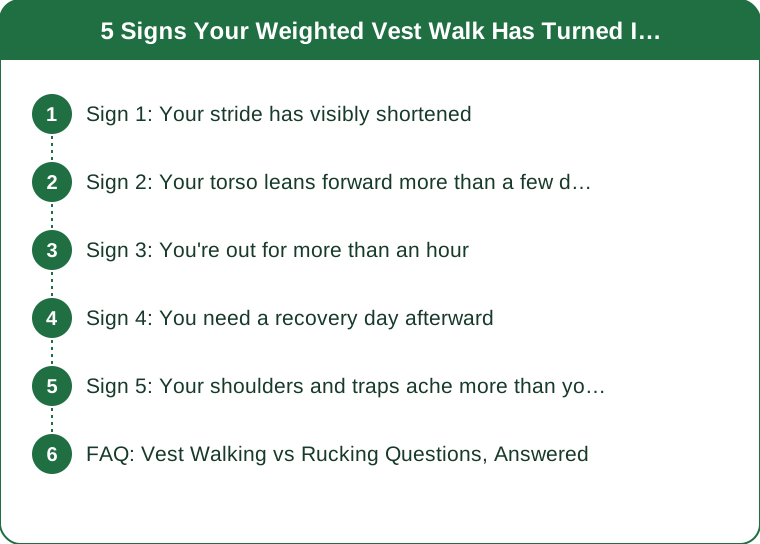
Quick Answer: A weighted vest walk becomes rucking when load, duration, and terrain combine to change your gait mechanics. The five signs are: your stride shortens, your torso leans forward, your walk length exceeds an hour, you need recovery days after, and your shoulders and traps ache more than your legs. Rucking is fine - but it needs different programming than a loaded stroll.
Most people start with a 10-lb vest and a 20-minute neighborhood loop. Eighteen months later they’re carrying 30 lbs for 90 minutes on hills and wondering why their hips hurt. The activity changed. The programming didn’t.

Sign 1: Your stride has visibly shortened
This is the clearest mechanical marker. Under light load, your gait stays essentially normal. Past roughly 10% of bodyweight, most people’s stride shortens and cadence rises - the body’s way of reducing single-leg loading time.
A shorter stride isn’t wrong, but it changes what you’re training. You’re now doing higher-frequency, higher-impact-per-mile work rather than a loaded version of your normal walk.
What it means for programming: treat it as a training session, not as a daily habit. Rucking with a shortened gait belongs 2-3 times a week with recovery in between - not every day, which is how many people treat vest walking.
Check it: film 15 seconds of yourself walking with and without the vest at the same speed. The difference is usually obvious on video and invisible from inside.
Sign 2: Your torso leans forward more than a few degrees
A vest sits on your torso, so the load is close to your center of mass and forward lean should be minimal. Lean increases when the vest is too heavy, sits too high, or is loaded unevenly front-to-back.
Sustained forward lean shifts work from your glutes to your lower back and increases compressive load on your lumbar spine over the whole session. This is where most weighted-walking injuries originate, and it builds slowly enough that nothing feels wrong until something does.
What to do: if you’re leaning, either reduce the load by 20% or redistribute it - move weight plates lower in the vest and balance front and back. A vest loaded heavily in front is a lean generator.
Check it: have someone photograph you from the side at minute 5 and minute 40 of the same walk. Comparing the two is more useful than either alone, because lean develops with fatigue.
Sign 3: You’re out for more than an hour
Duration is the variable people escalate most casually. Twenty minutes becomes thirty becomes an hour becomes ‘I’ll just do the whole loop.’
Past about 60 minutes under load, cumulative compression on the spine and cumulative stress on the feet, ankles, and knees become the limiting factor rather than the effort itself. This is exactly the territory where rucking programs build in progressive loading and rest weeks - because they have to.
What to do: if you’re regularly over an hour, adopt actual ruck programming. Alternate a long session, a short heavy session, and a recovery walk with no load. Progress either distance or weight in a given week - never both.
A reasonable ceiling for general fitness: 60-75 minutes at 10-15% bodyweight, two to three times a week.

Sign 4: You need a recovery day afterward
A loaded walk shouldn’t require recovery. If you’re stiff the next morning, your session has crossed into training stimulus territory - which is fine, but it means it needs to be programmed with rest rather than repeated daily.
The specific tell is stiffness in the hips and low back the next morning that eases within 20 minutes of moving. That’s a normal training response. Stiffness that persists all day, or any pain that’s sharp rather than diffuse, is a load reduction signal.
What to do: insert a genuine rest day, or an unloaded walk, between loaded sessions. Many people find their weighted walks feel dramatically better once they stop doing them on consecutive days.
Bone density benefits - one of the main reasons people take up weighted walking - come from progressive loading with adequate recovery, not from daily accumulation. More frequent is not better here.
Sign 5: Your shoulders and traps ache more than your legs
This is a fit problem masquerading as a fatigue problem. A well-fitted vest distributes load across your torso; a poorly fitted one hangs from your shoulders.
If your traps are the sore part, the vest is sitting too high, the straps are too loose, or there’s no effective waist strap transferring load to your hips. Over an hour, that’s your shoulders carrying weight your skeleton should be carrying.
What to do: tighten the waist strap first - it should be snug enough that the vest doesn’t bounce, sitting on the top of the pelvis rather than the waist. Then tighten the shoulder straps only enough to stop lateral sway. Most people do the reverse.
If your vest has no waist strap and you’re over 20 lbs, that’s the actual problem, and no adjustment fixes it. At that load a proper rucksack with a hip belt transfers weight far better than a vest designed for lighter work.
FAQ: Vest Walking vs Rucking Questions, Answered
What load counts as rucking rather than vest walking?
There’s no official line, but around 10% of bodyweight and 45+ minutes is where the mechanics and the programming needs both change noticeably.
Is rucking better than vest walking?
Neither is better - they’re different doses. Vest walking is an easy daily habit; rucking is a training session. Problems come from doing the second while programming it like the first.
Should I run in a weighted vest?
Generally not. Load plus impact multiplies joint stress substantially, and the injury risk rises faster than the benefit. Walk loaded, run unloaded. This is general information, not medical advice - existing joint or back issues warrant a professional conversation first.
TL;DR:
- Shortened stride, forward lean, 60+ minute duration, needing a recovery day, and trap soreness all signal you’ve crossed into rucking
- Rucking is fine, but it needs training programming: 2-3 sessions a week with rest, not daily habit treatment
- Progress weight or distance in a given week, never both
- Forward lean is the injury-relevant one; fix load distribution before anything else
- Trap soreness is a fit problem - tighten the waist strap first, shoulders second
The activity escalated gradually. The programming should have escalated with it.
Keep Reading
This article is for general informational purposes only and is not medical advice. Always consult a qualified health professional for guidance specific to you.