5 Signs Your Weighted Vest Is Sitting Too High on Your Torso
Quick Answer: A properly fitted weighted vest should sit snug against your torso with the bulk of its load around your ribcage and upper abdomen, not riding up toward your collarbone and shoulders — if any of the 5 signs below sound familiar, adjusting the straps or sizing down closes the gap and shifts load back where it belongs.
A weighted vest sitting too high isn’t just uncomfortable — it changes where the load actually goes, shifting stress toward your neck and shoulders instead of the core and postural muscles it’s meant to challenge.

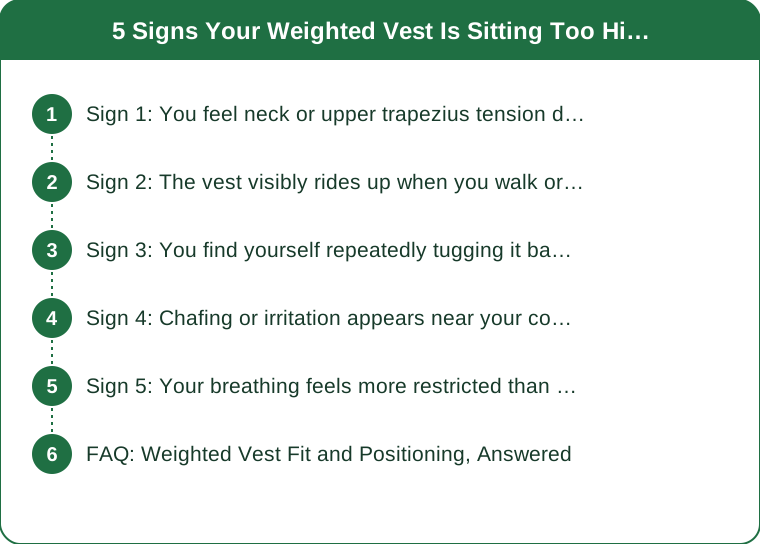
Sign 1: You feel neck or upper trapezius tension during or after wearing it
If tension shows up specifically in your neck or the muscles between your neck and shoulders, that’s a strong sign the vest’s weight is riding higher than intended and loading a part of your body it wasn’t designed to stress directly.
Sign 2: The vest visibly rides up when you walk or jog
A vest that visibly creeps upward during movement, rather than staying settled in place, usually indicates the torso straps aren’t snug enough or the vest itself is sized slightly too large, allowing it to migrate upward with each stride.
Sign 3: You find yourself repeatedly tugging it back down mid-session
This is one of the clearest behavioral signs — if you’re unconsciously adjusting the vest downward every few minutes, your body is responding to a fit issue even if you haven’t consciously identified it as one yet.

Sign 4: Chafing or irritation appears near your collarbone rather than lower on your ribs
Chafing location is a useful diagnostic — irritation concentrated high on the chest or near the collarbone, rather than lower around the ribs where a well-fitted vest’s edge typically sits, points to the vest riding higher than its intended fit position.
Sign 5: Your breathing feels more restricted than expected for the weight you’re carrying
A vest sitting too high can press against the upper chest and interfere with normal breathing mechanics more than a properly positioned vest would at the same total weight, since well-fitted vests distribute load lower, around the ribcage and upper abdomen, away from the areas most involved in normal breathing expansion.
FAQ: Weighted Vest Fit and Positioning, Answered
What’s the correct vest position it should actually sit at?
Most properly fitted vests sit with their top edge at or just below the collarbone and the main weight load concentrated around the ribcage and upper abdomen, not pressing directly against the neck or shoulders.
Does vest weight amount affect how much a high-riding fit matters?
Yes — heavier loads make a poor-fitting high position considerably more uncomfortable and risky than the same fit issue with a lighter vest, since more weight means more force concentrated on the wrong area.
Can adjusting the shoulder straps alone fix a high-riding vest?
Often partially, yes — tightening torso-level straps (not just shoulder straps) is usually what actually anchors the vest lower and prevents upward migration during movement.
TL;DR:
- A properly fitted vest concentrates load around the ribcage and upper abdomen, not the neck and shoulders
- Visible upward creep during movement and repeated mid-session tugging are both clear fit signals
- Chafing location near the collarbone, rather than lower on the ribs, points to a too-high fit
- Restricted breathing at a given weight can itself be a sign of poor vest positioning, not just the load
If two or more of these 5 signs sound familiar, the fix usually isn’t a lighter vest — it’s tightening the torso straps and letting the load settle where it’s actually designed to sit.
Keep Reading
This article is for general informational purposes only and is not medical advice. Always consult a qualified health professional for guidance specific to you.