5 Signs You Should Skip the Weighted Vest Today
Quick Answer: Skip the vest when your body is already carrying a load it has not recovered from. The five clearest signals are: morning stiffness in the achilles or feet, shoulder or trap soreness left over from the last vest session, a resting heart rate elevated more than about five beats above your normal, a poor night of sleep, or any gait change you can actually notice. A vest adds 10 to 20 percent to every step, so it multiplies existing problems rather than creating new ones.
The vest is a great tool precisely because it makes ordinary walking harder. That same property makes it a bad idea on the days your body is asking for less.

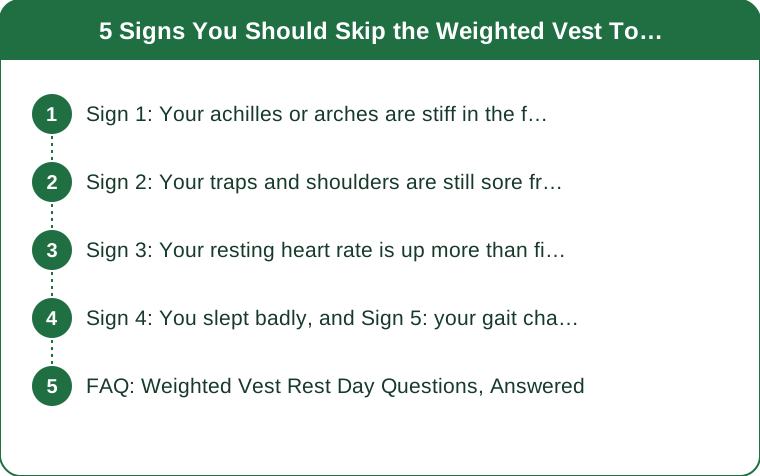
Sign 1: Your achilles or arches are stiff in the first steps of the morning
This is the single most important one, and it is easy to check because it happens before you have decided anything.
When you swing your legs out of bed, the first ten to fifteen steps tell you how your lower-leg tissue tolerated yesterday. Stiffness that eases within a minute of walking is the classic early sign of achilles or plantar fascia irritation, and the way it fades is exactly what convinces people to ignore it.
A weighted vest increases ground reaction force on every single step. If you walk 8,000 steps in a 15-pound vest, that is 8,000 slightly heavier landings through the tissue that was already complaining at 7 a.m.
Go without the vest. Walk the same distance. Reassess tomorrow morning. If the stiffness is gone, you made the right call and you lost nothing. If it is still there in three days, that is worth a professional conversation rather than a heavier vest.
Sign 2: Your traps and shoulders are still sore from last time
Vest soreness in the upper back is different from vest soreness in the legs, and it means something different too.
Leg soreness after a vest walk is expected loading. Trap and shoulder soreness usually means the vest sat too high, the straps were loose enough to let it bounce, or you were unconsciously shrugging to stabilize it. The muscle is doing postural work it was never meant to do for an hour.
Going again while sore does not build tolerance there. It reinforces the compensation, and over a few weeks it changes how you carry your head and shoulders, which is a much bigger problem than a sore trap.
Use the rest day to fix the setup instead. The vest should sit with its weight centered over your sternum and ribs, snug enough that you can pull the straps out about an inch and no more. Then walk 10 minutes and check whether your shoulders stay down.

Sign 3: Your resting heart rate is up more than five beats
If you track resting heart rate on a watch or ring, it is the cheapest readiness signal available.
A morning reading more than about five beats above your personal baseline typically reflects incomplete recovery, the beginning of an illness, dehydration, or accumulated stress. None of those are improved by adding external load.
The reason this matters specifically for vests: a weighted vest raises cardiovascular cost substantially at a walking pace that otherwise feels like nothing. A 20-pound vest can raise heart rate by 10 to 15 beats at the same walking speed, which turns your easy recovery walk into a moderate session without your permission.
On an elevated-HR day, walk without it and keep the pace conversational. That preserves the actual purpose of the walk, which was recovery and blood flow — the exact things the vest quietly cancels.
Sign 4: You slept badly, and Sign 5: your gait changed
Poor sleep is the most underrated contraindication. One bad night measurably reduces coordination, reaction time, and the quality of your movement patterns. Under a load, degraded coordination is how ankles roll and backs get tweaked stepping off a curb.
It also blunts the training benefit. The adaptation you are chasing with a vest — bone density, postural strength, work capacity — is built during recovery, and short sleep is the specific input that recovery lacks.
A noticeable gait change is the loudest signal of all. If you can feel yourself leaning forward, shortening your stride, landing harder on one side, or hearing your footfalls become uneven, the vest is already winning.
Here is the practical test: walk 200 steps in the vest and listen. Your footfalls should sound even and rhythmic. If one foot is louder, or the rhythm drifts as you tire, the load is beyond what your mechanics can hold cleanly today. Take it off and finish the walk unloaded. That is not quitting, that is the entire skill of using a vest well.
FAQ: Weighted Vest Rest Day Questions, Answered
How many days a week should I actually wear a vest?
For most people three to four days a week is plenty, with the rest of the walking done unloaded. Daily vest wear is where the overuse problems cluster, especially in the first few months.
If I skip today, should I add weight tomorrow to make up for it?
No. Missed load is not debt. Adding weight to compensate is the fastest route to the shoulder and achilles problems that caused the skip in the first place. Return to your normal weight and normal duration.
Can I wear a lighter vest instead of skipping entirely?
Sometimes, and it is a reasonable middle path for the sleep and resting-heart-rate signals. It is not appropriate for morning achilles stiffness or a visible gait change — those are structural signals, and a lighter version of the same load still points at the same tissue.
Does skipping days slow down bone density benefits?
Not meaningfully. Bone responds to consistent loading over months, and a handful of skipped days is invisible on that timeline. An injury that costs you six weeks is not.
This is general information, not medical advice.
TL;DR:
- A vest multiplies existing problems — it is a bad tool on days your body is already under-recovered.
- Morning achilles or arch stiffness is the most important skip signal, even though it fades as you walk.
- Leftover trap and shoulder soreness means a setup problem; fix the fit before you add another session.
- A resting heart rate more than five beats above baseline, or a bad night of sleep, both mean walk unloaded.
- Listen to your footfalls at 200 steps — uneven rhythm means the vest comes off now, not at the end.
The people who get the most from a weighted vest are not the ones who wear it every day. They are the ones who can tell the difference between a hard day and a bad day, and are willing to leave it on the hook.
Keep Reading
This article is for general informational purposes only and is not medical advice. Always consult a qualified health professional for guidance specific to you.