5 Signs Your Weighted Vest Is Too Heavy for What You're Doing
Quick Answer: A weighted vest is too heavy if it changes your posture, causes joint pain (especially knees or lower back), makes you noticeably slower or clumsier, causes chafing from excess movement, or leaves you more fatigued the next day than the workout should warrant. Most guidance caps loaded weight at around 10% of body weight for walking, less for running or high-impact work.
More resistance sounds like more benefit, but a weighted vest that’s genuinely too heavy for your activity creates more risk than reward. These five signs are the clearest indicators to size back down.

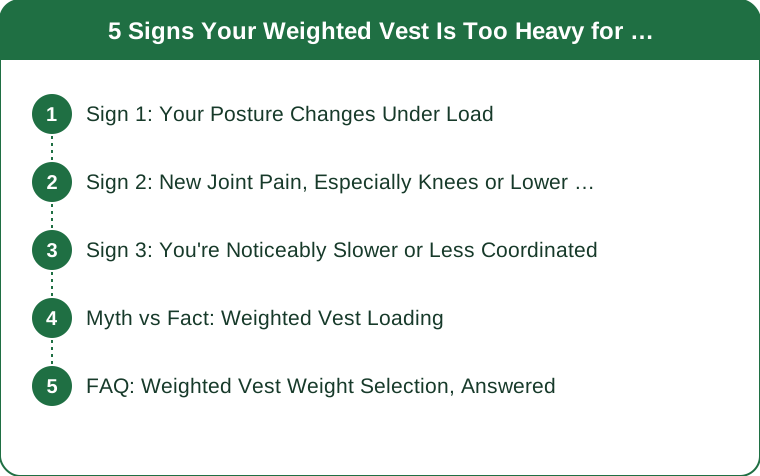
Sign 1: Your Posture Changes Under Load
If you notice yourself leaning forward, rounding your shoulders, or arching your lower back to compensate for the vest’s weight, that’s a clear sign the load exceeds what your current posture and core strength can support — and it defeats much of the vest’s benefit by shifting stress to your spine instead of your target muscles.
Sign 2: New Joint Pain, Especially Knees or Lower Back
Weighted vest training adds real compressive load through your joints with every step. New or worsening knee or lower back pain that wasn’t present during unweighted training is a direct signal the load is too high for your current joint capacity, not something to push through.

Sign 3: You’re Noticeably Slower or Less Coordinated
A small drop in pace with added weight is expected and fine. A dramatic change in gait, balance, or coordination signals the load is interfering with your movement pattern rather than simply adding resistance — this is when injury risk rises sharply.
Myth vs Fact: Weighted Vest Loading
Myth: A heavier vest always means a better workout. Fact: Beyond a certain point, excess weight compromises form and increases injury risk faster than it increases benefit — the 10% body weight guideline exists for good reason.
Myth: If you can walk in it, the weight is fine. Fact: Being able to complete the activity isn’t the same as doing it with good form — subtle compensations add up over repeated sessions.
FAQ: Weighted Vest Weight Selection, Answered
What’s a safe starting weight for a weighted vest?
Most guidance suggests starting around 5% of body weight for walking and progressing gradually, well below the 10% ceiling commonly cited for more experienced users.
Should running with a weighted vest use the same weight guideline as walking?
No — running adds far more impact force, so most guidance recommends a lower percentage (or avoiding vest weight for running entirely) compared to walking.
How do I know if I’ve adapted enough to add more weight?
If your current load feels easy with no posture change, no new joint discomfort, and normal next-day recovery over several consistent sessions, that’s the signal you can progress incrementally.
TL;DR:
- Posture changes, new joint pain, and reduced coordination are the clearest signs of overloading
- Most guidance caps weighted vest load around 10% of body weight for walking, less for running
- Being able to finish the activity isn’t the same as doing it with good form
- Progress load gradually only once your current weight feels easy with no compensations
A weighted vest adds the most benefit at a weight you can carry with unchanged form — past that point, it’s adding risk, not results.
Keep Reading
This article is for general informational purposes only and is not medical advice. Always consult a qualified health professional for guidance specific to you.